Thursday, May 10, 2007

The Great Plains -- A Retrospective

Calling Out Your Name

Well the moon moved past Nebraska
And spilled laughter on them cold Dakota Hills
And angels danced on Jacob's stairs
Yeah, they danced on Jacob's stairs
There is this silence in the Badlands
And over Kansas the whole universe was stilled
By the whisper of a prayer
The whisper of a prayer

And the single hawk bursts into flight
And in the east the whole horizon is in flames
I feel thunder in the sky
I see the sky about to rain
And I hear the prairies calling out Your name

I can feel the earth tremble
Beneath the rumbling of the buffalo hooves
And the fury in the pheasant's wings
And there's fury in a pheasant's wings
It tells me the Lord is in His temple
And there is still a faith that can make the mountains move
And a love that can make the heavens ring
And I've seen love make heaven ring

Where the sacred rivers meet
Beneath the shadow of the Keeper of the plains
I feel thunder in the sky
I see the sky about to rain
And I hear the prairies calling out Your name

From the place where morning gathers
You can look sometimes forever 'til you see
What time may never know
How the Lord takes by its corners this old world
And shakes us forward and shakes us free
To run wild with the hope

The hope that this thirst will not last long
That it will soon drown in the song not sung in vain
And I feel thunder in the sky
I see the sky about to rain
And I hear the prairies calling out Your name

And I know this thirst will not last long
That it will soon drown in the song not sung in vain
I feel thunder in the sky
I see the sky about to rain
And with the prairies I am calling out Your name

Rich Mullins
Psalms 19:1-6


It has been over twenty-five years since I left the Great Plains. I still carry with me the nasal southwest Kansas twang -- I will probably have it till my dying day. I had no appreciation for my homeland of western Kansas when I was growing up. It was a place to get away from. Definitely un-cosmopolitan, consisting mostly of wheat farms, pasture, cattle rances and prairie. Life revolved around planting and harvesting the wheat crop, getting cattle to market, Friday night football games or basketball games. Small farm towns, like Protection, where I grew up, were a symbiotic partner with the farms and ranches. I was a "town kid" -- my family provided services to the farmers, ranchers and townspeople. As the seventies hit, and the small farm was beginning to decline, I was one of those with stars in his eyes - who wanted to get far, far away from the seemingly dull existence that the high plains offered.

Rich Mullins, on the other hand, was making the journey in reverse. Already a "star" (though that is not what he intended to be and sought not to be), Rich came to the plains of Kansas as someone who could appreciate it's unique beauty for what it was -- and that is partly what he communicated in the song printed above, "Calling Out Your Name".

I came late to appreciate Rich Mullins. And I came late to appreciate my homeland. Better late than not at all.

Monday, May 07, 2007

Poor Man's Blackberry (tm)

Most people these days have a cell phone and most of them have an SMS or Text Messaging function. It is possible to use that feature to turn your phone into a "poor man's Blackberry". Most likely, you would not want to be notified of every email message that comes to your account, but would like to be kept aware of specific mail messages when the arrive.

Most corporate mail systems have the capability of user-created and user-managed rules regarding disposition of messages. In my case, if I'm away, I would like to know if I get email from my boss and I would also like to stay on top of the requests coming into the corporate help desk -- since they affect me, as a systems admin. So, to accomplish that, I set up a mail rule to do the job which I can turn on when I'm preparing to be away from work and turn off when I'm in the office.

My mail rule (see screenshot below) notices any Help Desk messages or any messages from Joe, my boss and routes a copy to my cell phone via text messaging.


The only real downsides to this approach are 1) SMS messages are limited in length and 2) your plan may charge by the message versus unlimited. My plan charges about .10 for each text message, but if I need it, it's no big deal, as far as I am concerned. This allows me to stay on top of what's going on Helpdesk-wise without being tied to the PC.

Sunday, May 06, 2007

Tornado Alley

Since yesterday morning, it has been hard to watch the cable news or the Weather Channel without seeing footage and commentary about the Greensburg, Kansas tornado. We were staying at a hotel preparing for our son's college graduation, as my Mom and Dad joined us for breakfast. Their first words were, "Did you hear about Greensburg?"

This was not the first tornado "experience" I have had, but the amount of devastation is hard to get my arms around. I was living in Emporia, Kansas in 1974 when a killer tornado struck, destroying a shopping mall, a large trailer court and a wide area of upper-middle-class apartments and residences. There were 12 fatalities. It was eerie. The description of Greensburg as "looking like a war zone" was used then, as well. I'm not sure they were using the rating scale on tornados that they are using today. I don't believe Emporia's tornado was an F5 like the one that took out Greensburg.

Years later, when we were living in Bloomington, Indiana -- a tornado struck on the the south side of Bedford, about twenty miles south with similar types of damage, only a much smaller area. The reason I write this is: I grew up very near Greensburg. I have been there and driven through there countless times in my growing up years. It is all very familiar to me -- and to watch from afar -- it is even more gripping for the memories of the town I knew, but is now nothing but rubble.

Finally (but one never knows), we have had a several tornados near our home in Junction City, Louisiana in the last few years. One came as near as half-a-mile and thankfully we had no damage though others a few miles down that tornado's track had localized but massive destruction, like the Greensburg photos.


Our prayers are with the people of Greensburg.

Addendum: My dad forwarded a news article that stated that the Greensburg tornado originated near my old hometown of Protection, Kansas -- accounting for the 20-30 minute warning that the residents of Greensburg had. Here is a link to a stormchaser site that covered another multi-tornado outbreak near Protection on April 23.

Tuesday, April 03, 2007

Shame on Me (Telling on Myself)

My wife, Cindy, and I traveled to Little Rock yesterday so that she could have a PET scan prior to making some decisions about her ongoing chemotherapy. I was sitting in the Imaging waiting room at Baptist Hospital while she was going through the process back somewhere in the bowels of the Imaging department.

I like to encourage Christians to speak up when there is an opportunity to choose the right thing and oppose the wrong thing. As it turns out, while I was sitting there a couple sat on a love seat next to where I was sitting. The said is wife would just go crazy if she didn't get to see "The Young and The Restless" and would anyone mind if he turned the TV to that channel. My response was, "I don't care one way or the other." As he changed the channels, I thought to myself, "You don't care? -- What do you mean 'I don't care one way or the other'?"

I had a good experience of Jesus admonition to take the log out of my own eye. How can I encourage others to do what I don't do myself? Shame on me!

Wednesday, March 07, 2007

Being a Follower: Closing Thoughts

Back to "following" -- what does it mean to be a follower? If you said: 1) going after something as it moves from place to place, 2) mimic or imitate, or 3) following instructions thoroughly from start to finish, you would be correct.

Some other, maybe not so obvious examples of "following" in the scriptures are:
Psalm 23

The LORD is my shepherd;
I shall not want.
He makes me to lie down in green pastures;
He leads me beside the still waters.
He restores my soul;
He leads me in the paths of righteousness
For His name’s sake.

Yea, though I walk through the valley of the shadow of death,
I will fear no evil;
For You are with me;
Your rod and Your staff, they comfort me.

You prepare a table before me in the presence of my enemies;
You anoint my head with oil;
My cup runs over.
Surely goodness and mercy shall follow me
All the days of my life;
And I will dwell in the house of the LORD
Forever.
Most sheep follow their shepherd. The ones who don't end up getting into trouble. In David's experience as a shepherd, he had a vital interest in the sheep that were entrusted to his care. He made sure they had the care, provision and protection they needed. His reputation depended on it.
Ruth 1:11-18

But Naomi said, “Turn back, my daughters; why will you go with me? Are there still sons in my womb, that they may be your husbands? Turn back, my daughters, go—for I am too old to have a husband. If I should say I have hope, if I should have a husband tonight and should also bear sons, would you wait for them till they were grown? Would you restrain yourselves from having husbands? No, my daughters; for it grieves me very much for your sakes that the hand of the LORD has gone out against me!”

Then they lifted up their voices and wept again; and Orpah kissed her mother-in-law, but Ruth clung to her.

And she said, “Look, your sister-in-law has gone back to her people and to her gods; return after your sister-in-law.”

But Ruth said:

“ Entreat me not to leave you,
Or to turn back from following after you;
For wherever you go, I will go;
And wherever you lodge, I will lodge;
Your people shall be my people,
And your God, my God.

Where you die, I will die,
And there will I be buried.
The LORD do so to me, and more also,
If anything but death parts you and me.”

When she saw that she was determined to go with her, she stopped speaking to her.
When the widowed Israelite Naomi and here widowed Moabite daughter-in-law Ruth were considering their futures during a famine in Moab's pagan environment, Naomi wanted to return to her own people and leave Ruth to start over again. Ruth's loyalty was expressed by her declaration that, as far as she was concerned, Naomi's people were her people. Naomi's god was her god. Naomi's land was her land. She would follow Naomi no matter what.
2 Tim 3:10-11

But you have carefully followed my doctrine, manner of life, purpose, faith, longsuffering, love, perseverance, persecutions, afflictions, which happened to me at Antioch, at Iconium, at Lystra—what persecutions I endured. And out of them all the Lord delivered me.
Paul was writing to his disciple Timothy, who had been through thick and thin with him. Paul knew that sending Timothy to do something was just that same as going himself, because Timothy would do it right. Paul reminded Timothy what following him had meant.
Hebrews 13:7

Remember those who rule over you, who have spoken the word of God to you, whose faith follow, considering the outcome of their conduct.
God requires that men aspire to leadership and in so doing, to model a life worth following. Having followers is not a gimme. It is earned.

Last, you can't be a leader unless you have learned to be a follower.

He leadeth me, O bless'd thought!
O words with heavenly comfort fraught!
Whate'er I do, where'er I be
Still 'tis God's hand that leadeth me.

He leadeth me, He leadeth me,
By His own hand He leadeth me;
His faithful follower I would be,
For by His hand He leadeth me.

Sometimes mid scenes of deepest gloom,
Sometimes where Eden's bowers bloom,
By waters still, over troubled sea,
Still 'tis His hand that leadeth me.

He leadeth me, He leadeth me,
By His own hand He leadeth me;
His faithful follower I would be,
For by His hand He leadeth me.

Lord, I would place my hand in Thine,
Nor ever murmur nor repine;
Content, whatever lot I see,
Since 'tis my God that leadeth me.

He leadeth me, He leadeth me,
By His own hand He leadeth me;
His faithful follower I would be,
For by His hand He leadeth me.

And when my task on earth is done,
When by Thy grace the victory's won,
E'en death's cold wave I will not flee,
Since God through Jordan leadeth me.

He leadeth me, He leadeth me,
By His own hand He leadeth me;
His faithful follower I would be,
For by His hand He leadeth me.

Tuesday, March 06, 2007

Being a Follower: No Longer In Control

After the "instant replay" of the fishing miracle, the risen Jesus prepared breakfast for his fishermen. Then he took some time to help Peter re-focus on what following him means for his life.
So when they had eaten breakfast, Jesus said to Simon Peter, “Simon, son of Jonah, do you love Me more than these?”
He said to Him, “Yes, Lord; You know that I love You.”
He said to him, “Feed My lambs.”
He said to him again a second time, “Simon, son of Jonah, do you love Me?”
He said to Him, “Yes, Lord; You know that I love You.”
He said to him, “Tend My sheep.”
He said to him the third time, “Simon, son of Jonah, do you love Me?”
Peter was grieved because He said to him the third time, “Do you love Me?”
And he said to Him, “Lord, You know all things; You know that I love You.”
Jesus said to him, “Feed My sheep.
Peter's calling, his life focus, is to care for God's people. The followers may have been thinking that the passion (arrest, trial, cross and resurrection) put an end to all that. It didn't put an end to following, it made it permanent.
Most assuredly, I say to you, when you were younger, you girded yourself and walked where you wished; but when you are old, you will stretch out your hands, and another will gird you and carry you where you do not wish.” This He spoke, signifying by what death he would glorify God. And when He had spoken this, He said to him, “Follow Me.”

Then Peter, turning around, saw the disciple whom Jesus loved following, who also had leaned on His breast at the supper, and said, “Lord, who is the one who betrays You?” Peter, seeing him, said to Jesus, “But Lord, what about this man?”

Jesus said to him, “If I will that he remain till I come, what is that to you? You follow Me.”
"Make hay while the sun shines" is an old cliche. Fact is, life tends to impose restrictions on us the older we get. Jesus was preparing Peter for what was ahead -- service, yes, then loss of freedom and comfort, then finally death. In Peter's case, it was a death much like the one he followed -- execution on a Roman cross. Jesus said that the time would come when Peter would be taken where he wouldn't have chosen to go. Like I said, circumstances, particularly aging imposes things on our lives that we don't choose and would like to avoid. That is why we need to make preparation while we can.

Peter had a way to make his ministry outlive him. He was a writer (at least he was a speaker who had a ghost writer). Through his letters, his travels, his speaking opportunities, he encouraged the believers to persevere under trial and obey -- to get their nourishment from the Scriptures and to be committed to maturity in life and character. He invested his life in younger men, like John Mark, who would continue after his death. This is how he "laid up treasure" in the Kingdom of Heaven. Today, 2000 years later, it is still paying off in my life, as well as others'.

A frequent topic in the news is how my generation -- the baby-boomers -- have not prepared for our retirement years. We might plan to bask on the sunny beaches in our golden years, but instead we end up as greeters at Wal-Mart so we can pay the bills. We did not save and invest, we did not prepare for that inevitability.

The same thing holds true for our service to the Kingdom of God. If we don't prepare for that inevitable time when we can't work like we used to, to let our investments in the Kingdom keep working for us and outlive us, we are missing an important point Jesus was making to his follower, Peter.

The same point is made by the apostle Paul and, in fact, the issue of preparing for what is to come is raised many times in the book of Proverbs. Seems like an important thing for a follower to pay attention to.

What will be leave behind? What will be our "legacy"? Presidents worry about their legacy, but it is not just for the rich and famous. It is for us little guys, too. Will others still be benefitting from my work after I'm gone?

Monday, February 19, 2007

Being a Follower: The Beginning

Take a look at the same series of precipitious events that led a bunch of "nobody" working-class guys to leave their comfort zones and become world-changers, even to this day. These events are "covered" from three perspectives, three sets of eyes. Consequently, the telling varies slightly from reporter to reporter.
Now when Jesus heard that John had been put in prison, He departed to Galilee. And leaving Nazareth, He came and dwelt in Capernaum, which is by the sea, in the regions of Zebulun and Naphtali, that it might be fulfilled which was spoken by Isaiah the prophet, saying:

"The land of Zebulun and the land of Naphtali, by the way of the sea, beyond the Jordan, Galilee of the Gentiles: The people who sat in darkness have seen a great light, and upon those who sat in the region and shadow of death Light has dawned.”

From that time Jesus began to preach and to say, “Repent, for the kingdom of heaven is at hand.”

And Jesus, walking by the Sea of Galilee, saw two brothers, Simon called Peter, and Andrew his brother, casting a net into the sea; for they were fishermen. Then He said to them, “Follow Me, and I will make you fishers of men.” They immediately left their nets and followed Him.

Going on from there, He saw two other brothers, James the son of Zebedee, and John his brother, in the boat with Zebedee their father, mending their nets. He called them, and immediately they left the boat and their father, and followed Him.

And Jesus went about all Galilee, teaching in their synagogues, preaching the gospel of the kingdom, and healing all kinds of sickness and all kinds of disease among the people. Then His fame went throughout all Syria; and they brought to Him all sick people who were afflicted with various diseases and torments, and those who were demon-possessed, epileptics, and paralytics; and He healed them. Great multitudes followed Him—from Galilee, and from Decapolis, Jerusalem, Judea, and beyond the Jordan. Matthew 4:12-25
Now after John was put in prison, Jesus came to Galilee, preaching the gospel of the kingdom of God, and saying, “The time is fulfilled, and the kingdom of God is at hand. Repent, and believe in the gospel.”
And as He walked by the Sea of Galilee, He saw Simon and Andrew his brother casting a net into the sea; for they were fishermen. Then Jesus said to them, “Follow Me, and I will make you become fishers of men.” They immediately left their nets and followed Him.

When He had gone a little farther from there, He saw James the son of Zebedee, and John his brother, who also were in the boat mending their nets. And immediately He called them, and they left their father Zebedee in the boat with the hired servants, and went after Him. Mark 1:14-20

Again, the next day, John stood with two of his disciples. And looking at Jesus as He walked, he said, “Behold the Lamb of God!” The two disciples heard him speak, and they followed Jesus. Then Jesus turned, and seeing them following, said to them, “What do you seek?” They said to Him, “Rabbi” (which is to say, when translated, Teacher), “where are You staying?” He said to them, “Come and see.” They came and saw where He was staying, and remained with Him that day (now it was about the tenth hour).

One of the two who heard John speak, and followed Him, was Andrew, Simon Peter’s brother. He first found his own brother Simon, and said to him, “We have found the Messiah” (which is translated, the Christ). And he brought him to Jesus. Now when Jesus looked at him, He said, “You are Simon the son of Jonah. You shall be called Cephas” (which is translated, A Stone).

The following day Jesus wanted to go to Galilee, and He found Philip and said to him, “Follow Me.” John 1:35-43
Fishing is all Peter, Andrew and the Zebedee brothers had known... It was the family business - they had grown up in it and most likely would pass it on to their sons. But Jesus said to "follow him" and they did.

Having looked at the three gospel narratives, let's take a "closer look" at the coup-de-grace that took Peter from the boats to his new life as a "follower":
So it was, as the multitude pressed about Him to hear the word of God, that He stood by the Lake of Gennesaret, and saw two boats standing by the lake; but the fishermen had gone from them and were washing their nets. Then He got into one of the boats, which was Simon’s, and asked him to put out a little from the land. And He sat down and taught the multitudes from the boat.

When He had stopped speaking, He said to Simon, “Launch out into the deep and let down your nets for a catch.”

But Simon answered and said to Him, “Master, we have toiled all night and caught nothing; nevertheless at Your word I will let down the net.” And when they had done this, they caught a great number of fish, and their net was breaking. So they signaled to their partners in the other boat to come and help them. And they came and filled both the boats, so that they began to sink. When Simon Peter saw it, he fell down at Jesus’ knees, saying, “Depart from me, for I am a sinful man, O Lord!”

For he and all who were with him were astonished at the catch of fish which they had taken; and so also were James and John, the sons of Zebedee, who were partners with Simon. And Jesus said to Simon, “Do not be afraid. From now on you will catch men.” So when they had brought their boats to land, they forsook all and followed Him. Luke 5:1-11
Jesus' hook in Andrew's life was the fact that Jesus was able to tell him where he had been and what he had been doing - sight unseen. For Peter, this unforgettable event sealed the deal. You can imagine working hard all night out on the water. You are getting ready to pack it in and some guy you hardly know tells you that if you throw the net where he tells you, there will be a catch. "Yeah, right. If you say so. If it makes you happy, okay, I'll give it a shot."

Surprise! Not only a catch but one that just about swamped two boats. Peter never forgot that one.

Three years later, we pick up the narrative again. This from John 21:
After these things Jesus showed Himself again to the disciples at the Sea of Tiberias, and in this way He showed Himself: Simon Peter, Thomas called the Twin, Nathanael of Cana in Galilee, the sons of Zebedee, and two others of His disciples were together. Simon Peter said to them, “I am going fishing.”

They said to him, “We are going with you also.” They went out and immediately got into the boat, and that night they caught nothing.
After all that had happened for the last three years, all that they had seen and heard
and been a part of in their "following" Jesus... They had been in the thick of miraculous works, great popularity on one side and intense hatred and opposition on the other. They had seen betrayal, abandonment and execution. They had seen their Master and Teacher twice - alive - after his execution.

They didn't quite know what to do with themselves. You can imagine their converstion, sort of like:
"What do we do now?"

"What do you want to do?"

"I don't know, what do you want to do?"

"Hey, I know! Let's go back to what we're comfortable with. Let's go fishing!"
Back to the narrative in John 21:
But when the morning had now come, Jesus stood on the shore; yet the disciples did not know that it was Jesus. Then Jesus said to them, “Children, have you any food?”
They answered Him, “No.”

And He said to them, “Cast the net on the right side of the boat, and you will find some.” So they cast, and now they were not able to draw it in because of the multitude of fish.

Therefore that disciple whom Jesus loved said to Peter, “It is the Lord!” Now when Simon Peter heard that it was the Lord, he put on his outer garment (for he had removed it), and plunged into the sea. But the other disciples came in the little boat (for they were not far from land, but about two hundred cubits), dragging the net with fish. Then, as soon as they had come to land, they saw a fire of coals there, and fish laid on it, and bread. Jesus said to them, “Bring some of the fish which you have just caught.”

Simon Peter went up and dragged the net to land, full of large fish, one hundred and fifty-three; and although there were so many, the net was not broken. Jesus said to them, “Come and eat breakfast.” Yet none of the disciples dared ask Him, “Who are You?”—knowing that it was the Lord. Jesus then came and took the bread and gave it to them, and likewise the fish. This is now the third time Jesus showed Himself to His disciples after He was raised from the dead.
Here we have deja vu (all over again). The event that hooked Peter three years ago is being replayed before their eyes. Sometimes we don't learn our lesson the first time - we have to have a little reminder.

To be continued...

Saturday, January 27, 2007

Living Hand-to-Mouth

You've probably heard the expression "God helps those who help themselves..." at least once in your life. Evangelical Christians are usually quick to retort with "...but you can't find that in the Bible!" They are correct... in that they are usually defending the biblical truth of justification. That is, being judicially absolved from our wrongdoing through Christ's substitutionary payment.

An interview with Thomas Sowell, a well-known independent-thinking economist, got me to consider this. He made a statement regarding social welfare funded by taxation. His comment was, "Why should I be required to provide for others what they are unwilling to provide for themselves." Sowell is big on personal responsibility -- and so is the Bible.

There is ample biblical support for both the cliche phrase ("God helps those...") and Mr. Sowell's comment -- speaking in terms of practical, everyday living.

First, I think of two Proverbs:

19:24. The sluggard buries his hand in the dish, But will not even bring it back to his mouth.

26:15. The sluggard buries his hand in the dish; He is weary of bringing it to his mouth again.

Next, Paul speaking to the Thessalonians (2 Thess. 3):

10. For even when we were with you, we used to give you this order: if anyone is not willing to work, then he is not to eat, either.

12. Now such persons we command and exhort in the Lord Jesus Christ to work in quiet fashion and eat their own bread.

There are some who would use the Bible as an escape from responsibility. Truth is, on balance, it helps us face responsibility head-on. If we were all more responsible, wouldn't the world be a better place?

Tuesday, July 11, 2006

Pirates of the Caribbean 2 - Even the Rocks Cry Out

I was one of the many moviegoers who helped Pirates 2 set box office opening records last weekend. I can't say I wasn't warned. I read a couple of reviews online before the matinee -- one at Slate and another at Chicago Tribune. They both led me to prepare for a veritable yawner.

It's not that it didn't have some notable aspects, though. The CG was very well done and well integrated into the film.

As we drove away from the theater, my lovely and perceptive wife, Cindy, made note of a couple of themes that kept surfacing in the storyline: paying your soul debt, facing final judgment and experiencing redemption.

As we talked about it she reminded me of Jesus statement when he rode into Jerusalem amid the cheers and adulation of the crowd. The religious leaders were offended and wanted Jesus to silence the crowd. They were aggressively suppressing the truth of the prophetic scenario playing out in front of them.

Jesus answered them, "If they are silent, even the rocks will cry out."

As hard as we try to silence the moral and spiritual themes of life, they keep popping up -- sometimes in places you would least expect them -- like Pirates of the Caribbean!

Thursday, June 15, 2006

Who Wrote Your Dictionary? - Part 3

A few years later, the apostle Paul took a page out of Jesus' dictionary and went into more detail about how love is defined:

If I speak in the tongues of men and of angels, but have not love, I am a noisy gong or a clanging cymbal. And if I have prophetic powers, and understand all mysteries and all knowledge, and if I have all faith, so as to remove mountains, but have not love, I am nothing. If I give away all I have, and if I deliver up my body to be burned, but have not love, I gain nothing. 1Co 13:1-3

Before he began explaining what love is, he talked about how important it is for us to have it. Love is the difference between being worth listening to and being background noise. Love is the difference between a being a beneficial and prosperous soul and being a nothing. Love makes the difference between our efforts being a benefit or a waste. He goes on to be specific in defining what live is like.

1Co 13:4 Love:

● love is patient - instead of having a short fuse, to be long spirited, long-suffering.
● love is kind - to show oneself useful, that is, act benevolently (like your mama said “why don't you make yourself useful!”)
● love does not envy – not motivated by jealously or wanting what doesn't belong to you
● love does not boast – not to be a braggart
● love is not arrogant – not inflated, proud, puffed up.

1Co 13:5

● love is not rude - not to be (that is, act) unbecoming: - behave self uncomely (unseemly).
● love does not insist on its own way
● love is not irritable – like a sharp jab in the side, that is, to exasperate: - not easily provoked
● love is not resentful – not keeping score, taking an inventory or keeping account of wrongs

1Co 13:6

● love does not rejoice at wrongdoing – not happy with injustice or unrighteousness
● love rejoices with the truth - sympathizes in gladness, congratulates truth


1Co 13:7 In all things - whatsoever, whosoever – everything that goes on in our lives:

● love bears - to roof over, that is, to cover with silence (to keep a lid on it)
● love believes - to have faith, to trust
● love hopes - to expect or confide
● love endures - to stay under (behind), persevere

Love never ends. As for prophecies, they will pass away; as for tongues, they will cease; as for knowledge, it will pass away. For we know in part and we prophesy in part, but when the perfect comes, the partial will pass away. When I was a child, I spoke like a child, I thought like a child, I reasoned like a child. When I became a man, I gave up childish ways. 1Co 13:8-11

Love is a characteristic of maturity, not of childishness.

Once again, the question for us, then, is “Who wrote your (my, our) dictionary?” Like we talked about in Part 1, definitions are descriptions of something.

If someone was asked to describe what your life was about, to sum up your life in a word or two, what would they say? What would they say is the love of your life? Is your life defined in terms of athletics? hunting? fishing? food? music? hobbies? sex? money? your work? Jesus?

Whatever or whoever defines your life is – in a practical sense – your God.

Paul talked sadly about ones he knew who let something other than Jesus define them.

Brothers, join in imitating me, and keep your eyes on those who walk according to the example you have in us. For many, of whom I have often told you and now tell you even with tears, walk as enemies of the cross of Christ. Their end is destruction, their god is their belly, and they glory in their shame, with minds set on earthly things. Phi 3:17-19

They let their own appetites define and control their lives. Don't let this be your life. Let the God who alone has the right to define you – truly be the definer of your whole life.

Tuesday, June 13, 2006

Who Wrote Your Dictionary? - Part 2

In Part 1, we looked at what "define" means and asked, “Who wrote your dictionary?” Who we get our definitions from makes a big difference in how we look at life and how we live it. Are God's definitions your definitions?

Don't let the world around you squeeze you into its own mold, but let God remake you so that your whole attitude of mind is changed. Rom 12:2 (Phillips)

As creatures and as God's people, we must be sure we get our definitions from God and not from those who think nothing of Him – and specially ones who oppose or resist Him.

The Beatles sang a song that said “Love, love, love – all you need is love...” but in real life, at the height of their fame, they could barely stand to speak to each other.

What if we were to ask someone like... let's say a rich and famous star or starlet or entertainer what love means, what would they say. They might say love is being head-over-heels for someone -- “crazy in love” -- something that takes off like a rocket, then cools off and goes sour. Then -- someone else comes along to be head-over-heels for. This is the world's mold that we need not to be squeezed into.

Question: What does “love” mean in Jesus' dictionary?

For if you love those who love you, what reward do you have? Do not even the tax collectors do the same? Mat 5:46

Love is not “giving to get.” Like Sammy Hagar singing “if you want love you've got to give a little...”

Jesus was asked: "Which commandment is the most important of all?" Jesus answered, "The most important is, 'Hear, O Israel: The Lord our God, the Lord is one. And you shall love the Lord your God with all your heart and with all your soul and with all your mind and with all your strength.' The second is this: 'You shall love your neighbor as yourself.' There is no other commandment greater than these." Mar 12:28-31

Love incorporates your whole being. It is not just emotional - a "feeling" you have . Put your heart into, your mind into it... and put your back into it. And God requires it of us (it's not optional) toward our neighbors, not just for Himself.

Jesus had devoted the last three years of his life to teaching twelve men and many other friends everything they could understand about God's purpose and will. The night before his death, at a private dinner and passover celebration he spent a lot of time talking to them about what love means – as He defines it. It was at this last supper that he instructed about love – more than any other single occasion in the gospels.

Now before the Feast of the Passover, when Jesus knew that his hour had come to depart out of this world to the Father, having loved his own who were in the world, he loved them to the end (To the utmost). Jesus, knowing that the Father had given all things into his hands, and that he had come from God and was going back to God, rose from supper. He laid aside his outer garments, and taking a towel, tied it around his waist. Then he poured water into a basin and began to wash the disciples' feet and to wipe them with the towel that was wrapped around him. Joh 13:1-5

"A new commandment I give to you, that you love one another: just as I have loved you, you also are to love one another. By this all people will know that you are my disciples, if you have love for one another." Joh 13:34-35

"If anyone loves me, he will keep my word, and my Father will love him, and we will come to him and make our home with him. Whoever does not love me does not keep my words. And the word that you hear is not mine but the Father's who sent me. Joh 14:23-24

As they got up from their meal and began walking to the Garden of Gethsemane, He continued to talk to them...

"As the Father has loved me, so have I loved you. Abide in my love. If you keep my commandments, you will abide in my love, just as I have kept my Father's commandments and abide in his love. These things I have spoken to you, that my joy may be in you, and that your joy may be full. "This is my commandment, that you love one another as I have loved you. Greater love has no one than this, that someone lays down his life for his friends. You are my friends if you do what I command you. No longer do I call you servants, for the servant does not know what his master is doing; but I have called you friends, for all that I have heard from my Father I have made known to you. You did not choose me, but I chose you and appointed you that you should go and bear fruit and that your fruit should abide, so that whatever you ask the Father in my name, he may give it to you. These things I command you, so that you will love one another." Joh 15:9-17

As they went, Jesus prayed. His prayer was for them and for us who have believed through them. Here is an excerpt of his prayer:

"And for their sake I consecrate myself, that they also may be sanctified in truth. "I do not ask for these only, but also for those who will believe in me through their word, that they may all be one, just as you, Father, are in me, and I in you, that they also may be in us, so that the world may believe that you have sent me. The glory that you have given me I have given to them, that they may be one even as we are one, I in them and you in me, that they may become perfectly one, so that the world may know that you sent me and loved them even as you loved me. Father, I desire that they also, whom you have given me, may be with me where I am, to see my glory that you have given me because you loved me before the foundation of the world. O righteous Father, even though the world does not know you, I know you, and these know that you have sent me. I made known to them your name, and I will continue to make it known, that the love with which you have loved me may be in them, and I in them." Joh 17:19-26

Jesus didn't say anything “mushy” when He talked about love. When He talked about love, He talked about commitment and service. He talked about something that originated in eternity and is long-lasting, not here today and gone tomorrow. He talked about learning what is right. He talked about doing right for Him and for the benefit of others.

He said love means laying down your life for others... giving up your own life for the sake of others. That may take many forms. In the heat of battle, a soldier might literally give up his life to save a comrade. In the battles of everyday life, we have to learn to let go of what we want for the good of those who depend on us.

Are Jesus's definitions your definitions?

Monday, June 12, 2006

Who Wrote Your Dictionary? - Part 1

Most of us know what a dictionary is and what it is used for -- correct spelling & pronunciation -- but especially meanings.

I looked up meanings of the word "define" at wordnet.princeton.edu/perl/webwn:
  • give the meaning of a word; "Define 'sadness'"
  • specify: determine the essential quality of (as in a specification... a blueprint callout)
  • determine the nature of; "What defines a good wine?"
  • show the form or outline of, differentiate; "The tree was clearly defined by the light"; "The camera could define the smallest object"

The Bible is a dictionary, too, and the Lord God is the original definer. “He said...” and it was. “He spoke...” and it was done.

In the beginning, God created the heavens and the earth. The earth was
without form and void, and darkness was over the face of the deep. and the
Spirit of God was hovering over the face of the waters. And God said, "Let
there be light," and there was light. And God saw that the light was good.
And God separated the light from the darkness. God called the light Day,
and the darkness he called Night. And there was evening and there was morning,
the first day. Gen 1:1-5

So it was with each of the next five days of creation. God defined and spoke:

Day two he created... The expanse. And it was so. And God called the expanse Heaven. And there was evening and there was morning, the second day. Gen 1:6-8

Day three he created... Oceans and land mass. God called the dry land Earth, and the waters that were gathered together he called Seas. And God saw that it was good. Gen 1:9-10

Vegetation. The earth brought forth vegetation, plants yielding seed according to their own kinds, and trees bearing fruit in which is their seed, each according to its kind. And God saw that it was good. And there was evening and there was morning, the third day. Gen 1:11-13

Day four he created... Sun, moon and stars. And God made the two great lights--the greater light to rule the day and the lesser light to rule the night--and the stars. And God set them in the expanse of the heavens to give light on the earth, to rule over the day and over the night, and to separate the light from the darkness. And God saw that it was good. And there was evening and there was morning, the fourth day. Gen 1:14-19

Day five he created... Sea creatures and birds. And God saw that it was good. It was an explosion of diversity -- not like Henry Ford's Model T -- “You can have any color you like as long as it's black.” And God blessed them, saying, "Be fruitful and multiply and fill the waters in the seas, and let birds multiply on the earth." And there was evening and there was morning, the fifth day. Gen 1:20-23

Day six he created... Livestock and land animals. And God made the beasts of the earth according to their kinds and the livestock according to their kinds, and everything that creeps on the ground according to its kind. And God saw that it was good. Then God said, "Let us make man in our image, after our likeness. And let them have dominion over the fish of the sea and over the birds of the heavens and over the livestock and over all the earth and over every creeping thing that creeps on the earth." So God created man in his own image, in the image of God he created him; male and female he created them. Gen 1:24-27

You see, God has the authority and power to define. In Isaiah 55:11 He says - “so shall my word be that goes out from my mouth; it shall not return to me empty, but it shall accomplish that which I purpose, and shall succeed in the thing for which I sent it.” God defined man's purpose and work.

He further defined the nature and boundaries of man's relationship with him:

And God blessed them. And God said to them, "Be fruitful and multiply and fill the earth and subdue it and have dominion over the fish of the sea and over the birds of the heavens and over every living thing that moves on the earth." And God said, "Behold, I have given you every plant yielding seed that is on the face of all the earth, and every tree with seed in its fruit. You shall have them for food. And to every beast of the earth and to every bird of the heavens and to everything that creeps on the earth, everything that has the breath of life, I have given every green plant for food." And it was so. And God saw everything that he had made, and behold, it was very good. And there was evening and there was morning, the sixth day. Gen 1:28-31

The LORD God took the man and put him in the garden of Eden to work it and keep it. And the LORD God commanded the man, saying, "You may surely eat of every tree of the garden, but of the tree of the knowledge of good and evil you shall not eat, for in the day that you eat of it you shall surely die." Gen 2:15-17

Then God gave Adam the authority and task of naming and classifying all the creatures he had dominion over:

So out of the ground the LORD God formed every beast of the field and every bird of the heavens and brought them to the man to see what he would call them. And whatever the man called every living creature, that was its name. The man gave names to all livestock and to the birds of the heavens and to every beast of the field. Gen 2:19-20

This is wonderful! What more could a man want? But... trouble came to Eden.

Now the serpent was more crafty than any other beast of the field that the LORD God had made. He said to the woman, "Did God actually say, 'You shall not eat of any tree in the garden'?" And the woman said to the serpent, "We may eat of the fruit of the trees in the garden, but God said, 'You shall not eat of the fruit of the tree that is in the midst of the garden, neither shall you touch it, lest you die.'" But the serpent said to the woman, "You will not surely die. For God knows that when you eat of it your eyes will be opened, and you will be like God, knowing good and evil." Gen 3:1-5

Satan sought to “re-define” what God has said. He suggested that God didn't really mean what he said and the He only said it to hold Adam and Eve back from being equal with Him. Satan is still does that today. He has a rival system that does not recognize God's authority or definitions.

God wrote the dictionary for His creation. So, then, “Who wrote your dictionary?” Who we get our definitions from makes a big difference in how we look at life and how we live it. Are God's definitions your definitions?

Sunday, May 07, 2006

Faith: Something You Have or Something You Do?

Answer: Both, actually. But since we usually focus on "having" faith, I want to look at the active, action-oriented faith that the Bible promotes. Hebrews 11:1 says:

"Now faith is the assurance of things hoped for, the conviction of things not seen."

Let's pick this apart, using the Strong's Concordance as a starting point for Greek definitions.

Faith = pistis (4102) - Being convinced of and relying on something.

Assurance = hupostatis (5287) - Substance, title-deed, guarantee, reality.

Hope = elpizo (1679) - Being fully confident in something, though not yet in grasp.

Conviction = elegchos (1650) - Evidence, proof (that by which a thing is tested and proven).

Things = pragma (4229) - Accomplished fact, that which exists, a "done deal".

Seen = blepo (991) - Perceived by the eye.

In other words, rather than having some nebulous feeling, you might rather say that:

Faith - the Godly, Bible kind - substantiates - or gives substance to - things which are fully assured. It evidences - proves by testing - things which are very real, even though they may not be seen by the eye. One translation says "unseen realities". That puts it rather well.

To use an analogy, I think of the character "the Invisible Man" in the old movie. Putting on a hat, coat, gloves, face wrapping - these things verified what was otherwise invisible. So by relying on and acting on what God says is reality, we prove what is unseen.

Wednesday, March 22, 2006

Why was Drudge surprised?

"Shock" was the lead-in to the Drudge headline link to this news story about infanticide in North Korea. Why is this news a surprise? For a materialist/evolutionist, weeding out the weak is a mechanism of the great evolutionary "plan" being worked out over the eons. To be a consistent evolutionist, this would be a good thing.

On the other hand, there was Corrie tenBoom. After the Nazis invaded Holland in 1940, Miss tenBoom was ostracized by the Nazi occupiers for befriending disabled children and helping them learn, in their simple way, the love that God has for them. Her God requires consideration for the helpless... in fact, the prophets pronounced judgment for lack of it. Conversely, in the Nazi way of thinking, this was useless activity wasted on worthless people. See a pattern here?

What journalist/poet Steve Turner wrote in his poem "Chance" is fitting here:


Chance

If chance be
the Father of all flesh,
disaster is his rainbow in the sky,
and when you hear

State of Emergency!
Sniper Kills Ten!
Troops on Rampage!
Whites go Looting!
Bomb Blasts School!

It is but the sound of man
worshipping his maker.

Steve Turner,
from Up To Date (London: Hodder & Stoughton)

Thursday, March 16, 2006

Elijah and the Prophets of Secularism

... or Dance With The One Who Brung Ya (Part 2)

There's trouble brewin' in South Dakota. Those uppity hicks exercised their choice... they went and chose life for the unborn instead of extermination. Now the abortion at any cost folks are up in arms.

We are reaching a collision point regarding many of our "values" and people must decide where they stand. I am reminded of Elijah and the prophets of Baal. He told the "folks" in Israel that decision time had arrived. They had to choose where their allegiance lay and by whom their values would be guided (determined, if you will.)

Elijah promptly challenged them, and the leaders of the competing worldview, to a showdown. It was kind of like, as Jesus said, "by their fruits your will know them." Elijah was forcing them to their endgame -- and doing the same for himself -- to see what each one would produce. As the story goes, his opponents wore themselves out trying to get results. Elijah sat by and watched and gave commentary. Then he set up the test challenge for himself and made it much more difficult for himself than it had been for them. With a single prayer, the God who answered with fire was the true God... Elijah's God.

It is time for the players in our modern cultural debate to come to epistemological self-consciousness... to face who they are and how they got here and what the outcome of those things taken to the extreme will produce. Like Jesus said, " Each tree is recognized by its own fruit. People do not pick figs from thornbushes, or grapes from briers."

Wednesday, March 15, 2006

Looking Forward... a worthwhile habit

Have you ever driven by a half-finished building that has obviously been that way for quite a while... even to the point where the elements are starting to take a toll on the structure and it is starting to decay and fall apart?

Jesus from Luke 14:28-32:

"Suppose one of you wants to build a tower. Will he not first sit down and estimate the cost to see if he has enough money to complete it? For if he lays the foundation and is not able to finish it, everyone who sees it will ridicule him, saying, 'This fellow began to build and was not able to finish.' Or suppose a king is about to go to war against another king. Will he not first sit down and consider whether he is able with ten thousand men to oppose the one coming against him with twenty thousand? If he is not able, he will send a delegation while the other is still a long way off and will ask for terms of peace. "


Building projects require a lot of forethought and "foreaction". Builders don’t just show up one day and say “we’re ready.” It required making plans, checking codes and boundaries, determining materials and labor required, counting the cost, staking it out, preparing the foundations, ordering the materials, scheduling the work and much more. The bigger the project the more there is to do.

There is a great deal of debate about "the wall of separation" between church and state. Modern American Christians, unfortunately, have a habit creating a "wall of separation" between faith and life. The Bible in general, and Proverbs in particular, knows of no such separation. Examples:

Having a harvest requires working the ground and being persistent. Just thinking about it will leave you empty-handed.

Proverbs 12:11 He who works his land will have abundant food, but he who chases fantasies lacks judgment.

Proverbs 20:4 A sluggard does not plow in season; so at harvest time he looks but finds nothing.

Proverbs 13:4 The sluggard craves and gets nothing, but the desires of the diligent are fully satisfied.

Proverbs 28:19 He who works his land will have abundant food, but the one who chases fantasies will have his fill of poverty.

Titus 3:1 Remind them... to be ready for every good work...


God commends planning for the future - but he always has the last word.

Proverbes 16:1,9 To man belong the plans of the heart,but from the LORD comes the reply of the tongue. In his heart a man plans his course, but the LORD determines his steps.

Proverbs 21:31 The horse is made ready for the day of battle, but victory rests with the LORD.


Prudent men see what is ahead and make preparation for it.

Proverbs 22:3 A prudent man sees danger and takes refuge, but the simple keep going and suffer for it.

Proverbs 27:12 The prudent see danger and take refuge, but the simple keep going and suffer for it.

Hebrews 11:7 By faith Noah, being divinely warned of things not yet seen, moved with godly fear, prepared an ark...

Anticipating Gain

We do all this in view of the future benefit we expected to get from the work. We “plow in hope.”

Paul from 1 Corinthians 9:10, 24-27 …when the plowman plows and the thresher threshes, they ought to do so in the hope of sharing in the harvest. Do you not know that in a race all the runners run, but only one gets the prize? Run in such a way as to get the prize. Everyone who competes in the games goes into strict training. They do it to get a crown that will not last; but we do it to get a crown that will last forever. Therefore I do not run like a man running aimlessly; I do not fight like a man beating the air. No, I beat my body and make it my slave so that after I have preached to others, I myself will not be disqualified for the prize.

Nobody goes into business just to get by. Why run if not to win? Let’s look at more examples of Paul’s labors…

Thessalonica Acts 17:1-9 When they had passed through Amphipolis and Apollonia, they came to Thessalonica, where there was a Jewish synagogue. 2As his custom was, Paul went into the synagogue, and on three Sabbath days he reasoned with them from the Scriptures, 3explaining and proving that the Christ had to suffer and rise from the dead. "This Jesus I am proclaiming to you is the Christ," he said. 4Some of the Jews were persuaded and joined Paul and Silas, as did a large number of God-fearing Greeks and not a few prominent women. 5But the Jews were jealous; so they rounded up some bad characters from the marketplace, formed a mob and started a riot in the city. They rushed to Jason's house in search of Paul and Silas in order to bring them out to the crowd. 6But when they did not find them, they dragged Jason and some other brothers before the city officials, shouting: "These men who have caused trouble all over the world have now come here, 7and Jason has welcomed them into his house. They are all defying Caesar's decrees, saying that there is another king, one called Jesus." 8When they heard this, the crowd and the city officials were thrown into turmoil. 9Then they made Jason and the others post bond and let them go.

The testimony of those who opposed Paul was that he and his co-workers had “caused trouble all over the world…” and they recognized that the message Paul brought was not to bring “just one more god” to the mix, but rather that Jesus was greater than Caesar.

Ephesus Acts 19:8-10, 25-27 8Paul entered the synagogue and spoke boldly there for three months, arguing persuasively about the kingdom of God. 9But some of them became obstinate; they refused to believe and publicly maligned the Way. So Paul left them. He took the disciples with him and had discussions daily in the lecture hall of Tyrannus. 10This went on for two years, so that all the Jews and Greeks who lived in the province of Asia heard the word of the Lord. 23About that time there arose a great disturbance about the Way. 24A silversmith named Demetrius, who made silver shrines of Artemis, brought in no little business for the craftsmen. 25He called them together, along with the workmen in related trades, and said: "Men, you know we receive a good income from this business. 26And you see and hear how this fellow Paul has convinced and led astray large numbers of people here in Ephesus and in practically the whole province of Asia. He says that man-made gods are no gods at all. 27There is danger not only that our trade will lose its good name, but also that the temple of the great goddess Artemis will be discredited, and the goddess herself, who is worshiped throughout the province of Asia and the world, will be robbed of her divine majesty."

Paul and his co-workers were able to communicate the Lordship of Christ throughout the whole region.

Population Statistics

We are praying for revival – that is good. If there was revival on the massive scale that the statistics require – what would be needed? How can we prepare? Pastors can’t handle it all. Revival wouldn’t bring in only the “upper crust.” It would bring in people who have needs and problems – marital, substance abuse, money, thievery, adultery, etc. How are we preparing to be involved in the training of others? Our commission is to be Jesus Christ’s learners and to teach others to be learners.

Sunday, February 19, 2006

Following the Footprints

My wife and I are avid mystery fans. Myself, mystery TV and DVD's, she, mystery books as well. One thing common to most modern crime shows is the forensics unit. They are there after the crime as been discovered. They accumulate physical evidence -- fingerprints, footprints, DNA samples and much more. Their science enables those looking for the perpetrator to follow these leads to the guilty party.

I have been thinking about how modern science, which I will dub "un-science", is far different from its heritage. The scientists of old who laid the foundations for modern science -- Faraday, Boyle, Lord Kelvin and many more -- were like the detectives mentioned above. They followed the fingerprints and footprints where they led. It was not improper in their eyes to recognize when the evidence led them to someone who was no longer inside the room.

Un-science has decided -- not based on evidence, mind you, but rather on presupposition -- that they can only deal with things inside the room. Nothing exists outside the room. The fingerprints, footprints and other forensic evidence must be attributed to things inside the room, tangible or postulated. Those who are still willing to recognize that the footprints lead outside the door are held in derision.

The writer of Hebrews stated in chapter 12:3 that "by the word of God, we recognize that the creation was made of things which are not visible." Imagine that. A first century writer stating without curiosity that the elements are made of things not visible to the naked eye.

Even though we have technology today like scanning tunnel microscopy, we can't really see atoms. We know with certainty they are there, can detect their presence and manipulate them. Even un-scientists believed in things they couldn't see for a long time. They didn't consider it any less scientific to do so, as long as it was done on their own terms.

Paul, the writer of the letter to the Romans said, "The wrath of God is being revealed from heaven against all the godlessness and wickedness of men who suppress the truth by their wickedness, since what may be known about God is plain to them, because God has made it plain to them. For since the creation of the world God's invisible qualities, his eternal power and divine nature, have been clearly seen, being understood from what has been made, so that men are without excuse."

In other words, "men who know better bend the truth to their own liking. In doing so, they violate what God has made evident to them, and consequently will be without excuse when they are called to account."

What will happen when those who hold to un-science are probed as to why they were willing, on their own terms exclusively, to believe in things they couldn't see, but unwilling to follow the footprints wherever they led -- even "outside the room?"

Thursday, February 02, 2006

Eminent (Digital) Domain - The RIM Problem

Well, it was bound to happen. Eminent domain is not new. For many years, the property of individuals has been condemned by the civil government (local, state or federal) in order to acquire it for some needed public works project -- a bridge, a highway, whatever... The only consolation for the loser, er, uhh, property owner was that they were to be given fair compensation for their property loss.

Recently, there has been a lot of hubbub in the news about the use of eminent domain to take property from the little guy and transfer ownership to some big business entity to be used for something that gives a little better tax base for the municipality... taking the property of individuals and selling it to a corporate entity for building a mall or an apartment complex or a condo project so that the city budget can get a little more benefit from it.

Now enter the next frontier. RIM (Blackberry to the folks) has been embroiled in a patent infringement suit with small US company for several years. The case has reached the point where, unless RIM pays a percentage to the patent owner, the entire Blackberry network will be shut down. This does not sit well with those who have become addicted to the little beggars delivering their e-mail here, there and everywhere. I say addicted because users have even nicknamed them "crackberries" (alluding to crack cocaine) because, well, you get the idea... And I admit, they are a wonderful tool to those who need omnipresent email. I know, I support the Blackberry services for a major corporation.

Here is the rub. If NTP's patent holds up in court, and this is still not definitely established, the US government may step in and pull an eminent domain on them. In this sense, they would be condemning the intellectual property of NTP and co-opting it for the "greater good" of Blackberry users everywhere. This stands to obliterate any sense of intellectual property rights. RIAA... maybe you are next.

Thursday, January 19, 2006

Dance With the One Who Brung Ya

This past fall has been an interesting one for those standing on the sidelines of the attempts to have school curriculum call Darwinism what it really is -- a theory. Of course, no one is truly on the sidelines on this one.

It is fascinating to watch "true believers" in Darwinism engage in behavior that one would typically ascribe to theists. This includes everything from revival-preacher fury in support of this (oxymoronically) absolutely true theory to dreamy-eyed platitudes about the wonderfulness of this lovely mechanism that has, in the mind of the beholder, made us what we are.

Several good, level-headed reads in this regard... from Bob Murphy, PhD in Economics from NYU and Eric Rauch. Murphy discusses reasons why arguments for Darwinism are not necessarily the slam dunk they are made out to be. Rauch discusses recent articles that portray a philosophical "love fest" for natural selection.

I'm biased, I admit it. Like I said, no one is really on the sidelines in this one. However, to bring this into line with the title... If natural selection is a good thing (the one who brung us) -- that means the strong conquering the weak is a good thing. That means being a predator is better than being a servant. Glamorizing natural selection won't undo this fact. Saying that we have evolved to a point where, now -- taking care of the weak, being servants instead of predators, being others-oriented, caring for our fellow man is the natural law -- this flies in the face of that cold emotionless process that supposedly brought us here.

We can't have it both ways. Ya gotta dance with the one who brung ya -- and in time, the real "bringer" will be evident.

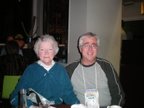
John and Cindy

John and Cindy
Kings Cross, London UK 2007